


If you are buying or selling a home in Texas, one of the most important concepts to understand is agency. Agency defines who represents whom, what duties are owed, and how loyalty, confidentiality, and disclosure work in a real estate transaction.
Many consumers assume that every real estate agent in a deal represents both sides equally. In Texas, that is not automatically true. Agency relationships are regulated by the Texas Real Estate License Act (TRELA) and enforced by the Texas Real Estate Commission (TREC). These laws exist to protect the public and to clearly define the responsibilities of real estate license holders.
This guide breaks down Texas real estate agency relationships in plain English, including fiduciary duties, intermediary status, and what buyers and sellers should understand before entering any agreement.
What Is an Agency Relationship in Texas Real Estate?
An agency relationship is a legal relationship where one party (the agent) is authorized to act on behalf of another party (the principal). In real estate, the principal is usually the buyer, the seller, or the landlord or tenant.
Once agency is created, the agent owes the client a set of fiduciary duties. These are the highest duties recognized under the law.
In Texas, agency relationships are not automatic. They are typically created through a written representation agreement, such as:
- A buyer representation agreement
- A listing agreement
- A tenant representation agreement
Texas law also requires agents to provide consumers with the Information About Brokerage Services form, which explains the different types of agency relationships available.
The Fiduciary Duties Agents Owe Their Clients
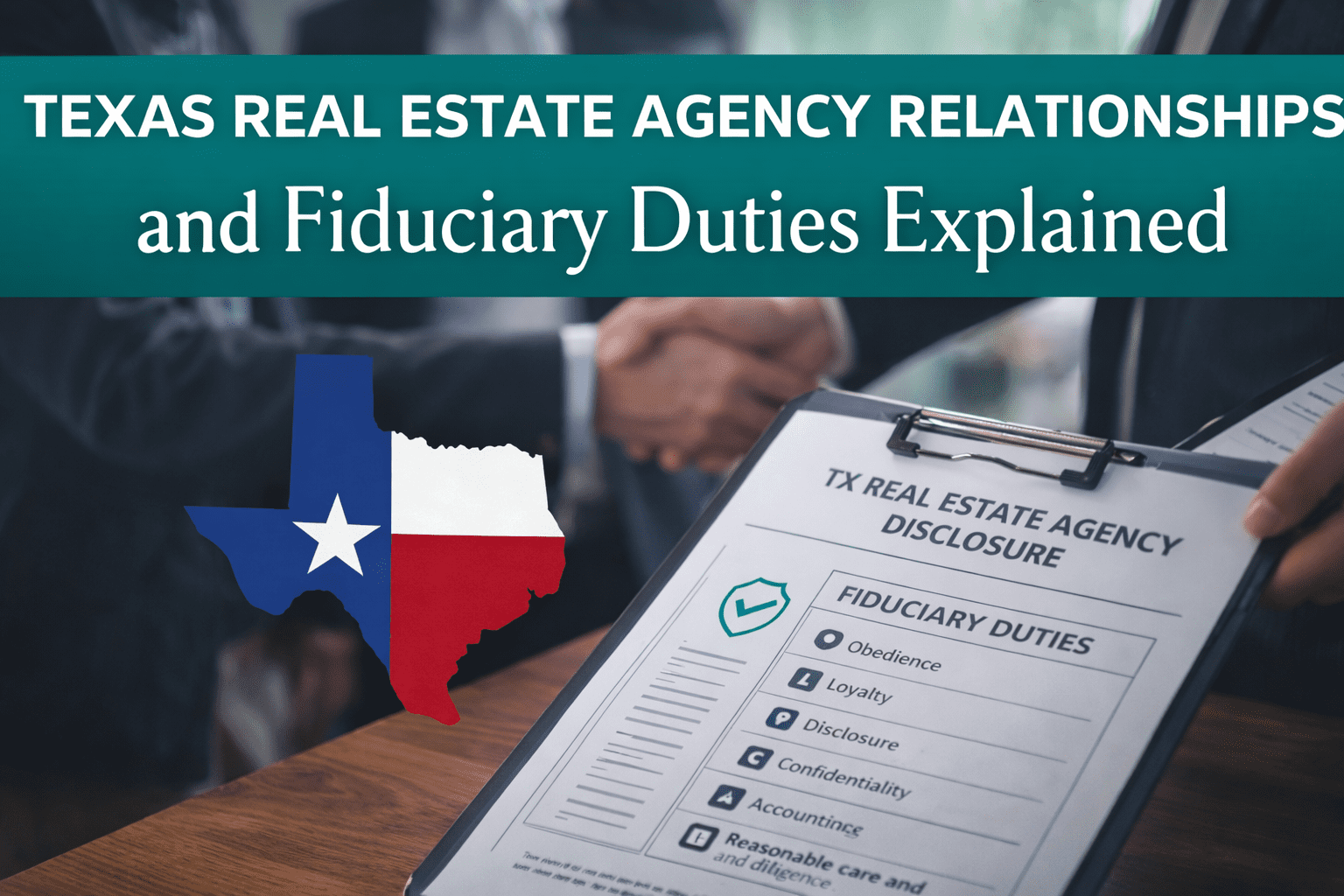
When an agent represents a client in Texas, they owe six primary fiduciary duties. These are often remembered using the acronym OLD CAR.
Obedience
The agent must follow all lawful instructions from the client.
Loyalty
The agent must act in the client’s best interest at all times, even above their own interests.
Disclosure
The agent must disclose all material facts that could affect the client’s decisions.
Confidentiality
The agent must protect the client’s confidential information, even after the relationship ends.
Accounting
The agent must properly account for money, documents, and property.
Reasonable care and diligence
The agent must act competently and in a timely, professional manner.
These fiduciary duties are central to Texas real estate law. Violating them can result in disciplinary action, including license suspension or revocation.
Common Types of Agency Relationships in Texas
Texas does not recognize “dual agency” in the traditional sense. Instead, Texas uses a unique structure called intermediary status.
Here are the most common agency relationships you will encounter.
Seller’s Agent
A seller’s agent represents the property owner. Their primary duty is to the seller.
Typical responsibilities include:
- Marketing the property
- Advising on pricing and strategy
- Negotiating offers
- Disclosing material facts
- Protecting the seller’s confidential information
A seller’s agent owes no fiduciary duty to the buyer, even though they must treat the buyer honestly and fairly.
If you are selling, your agent should be clearly working in your best interest from pricing through closing.
Buyer’s Agent
A buyer’s agent represents the buyer and owes fiduciary duties exclusively to them.
Typical responsibilities include:
- Helping identify suitable properties
- Providing market analysis
- Advising on offer strategy
- Negotiating on the buyer’s behalf
- Protecting confidential information such as motivation, budget, or urgency
A buyer’s agent’s loyalty belongs to the buyer, not the seller, even if the home is listed by the same brokerage.
If you are buying, working with a buyer’s agent gives you dedicated advocacy throughout the process. If you are just starting out, the Start Here page is a good place to understand how buyer representation works.
https://patrickscotthomes.com/start-here
Intermediary Relationship
Texas allows a brokerage to act as an intermediary when both the buyer and seller are represented by agents in the same brokerage.
This is not automatic. It must be agreed to in writing by both parties.
There are two forms of intermediary:
Intermediary with Appointments
Each party is assigned a different agent within the same brokerage. Those agents owe full fiduciary duties to their respective clients. The broker remains neutral.
Intermediary without Appointments
The same agent works with both parties. In this case, the agent cannot provide advice that favors one side over the other.
In any intermediary situation, the broker and agents:
- Must treat both parties honestly and fairly
- Must disclose known material facts
- Cannot disclose confidential information
- Cannot advocate one side over the other
This structure is meant to allow brokerages flexibility while still protecting consumers.
Non-Agency Relationships
Not every interaction creates agency.
An agent may act as a non-agent, sometimes referred to as a facilitator or transaction broker, depending on the context. In this role, the agent does not represent either party.
They may assist with:
- Providing forms
- Relaying communications
- Coordinating steps in a transaction
But they do not owe fiduciary duties.
This type of relationship offers less protection for consumers and should always be clearly understood before proceeding.
Why Written Disclosure Matters in Texas
Texas law is very specific about disclosure.
Agents must provide the Information About Brokerage Services notice at the first substantive communication. This document explains:
- Who the agent may represent
- What fiduciary duties mean
- How intermediary relationships work
- What consumers can expect
In intermediary situations, written consent is required.
These disclosure rules exist to prevent confusion and protect the public from unknowingly entering into agency relationships they do not understand.
How Agency Affects Negotiations
Agency directly impacts how negotiations work.
A seller’s agent cannot advise a buyer on how low the seller will go.
A buyer’s agent cannot reveal a buyer’s top price without permission.
In intermediary situations, the agent may be restricted from giving negotiation advice entirely.
Understanding this changes how you:
- Interpret guidance
- Share personal motivation
- Handle offer strategy
- Choose representation
This is one reason working with the right agent matters. Representation affects not just paperwork, but outcomes.
Agency, TRELA, and Consumer Protection
The Texas Real Estate License Act exists primarily to protect the public from dishonesty, misrepresentation, and incompetence.
Agency law is one of its most important tools.
By clearly defining:
- Who is represented
- What duties are owed
- What disclosures are required
- What conduct is prohibited
TRELA helps prevent conflicts of interest and predatory practices.
If you want a deeper breakdown of how TRELA protects buyers and sellers, you can read the full overview here:
https://patrickscotthomes.com/blog/texas-real-estate-license-act-trela
What Buyers and Sellers Should Do
Before signing anything, every buyer and seller in Texas should:
- Ask who the agent represents
- Review the Information About Brokerage Services form
- Understand intermediary options
- Clarify confidentiality protections
- Confirm fiduciary responsibilities
Agency is not just a formality. It defines whose side someone is legally on.
If you are preparing to buy, selling, or still exploring your options, the buyer and seller guides may help you understand how representation fits into the bigger picture.
https://patrickscotthomes.com/buyers
https://patrickscotthomes.com/sellers
Final Thoughts
Texas real estate agency law is detailed, but its purpose is simple: protect consumers and ensure fair, transparent representation.
Understanding agency relationships and fiduciary duties empowers you to:
- Choose the right representation
- Protect your interests
- Avoid conflicts
- Navigate transactions with confidence
Whether you are buying your first home, selling a long-time property, or planning an investment, knowing how agency works gives you leverage, clarity, and protection.
Related Reading
Start Here: A Guide for Dallas Area Buyers and Sellers
https://patrickscotthomes.com/start-here
Your Guide to Buying a Home in Dallas and Surrounding Areas
https://patrickscotthomes.com/buyers
Your Guide to Selling a Home in Dallas and Surrounding Areas
https://patrickscotthomes.com/sellers
What Is TRELA? Understanding the Texas Real Estate License Act
https://patrickscotthomes.com/blog/texas-real-estate-license-act-trela