


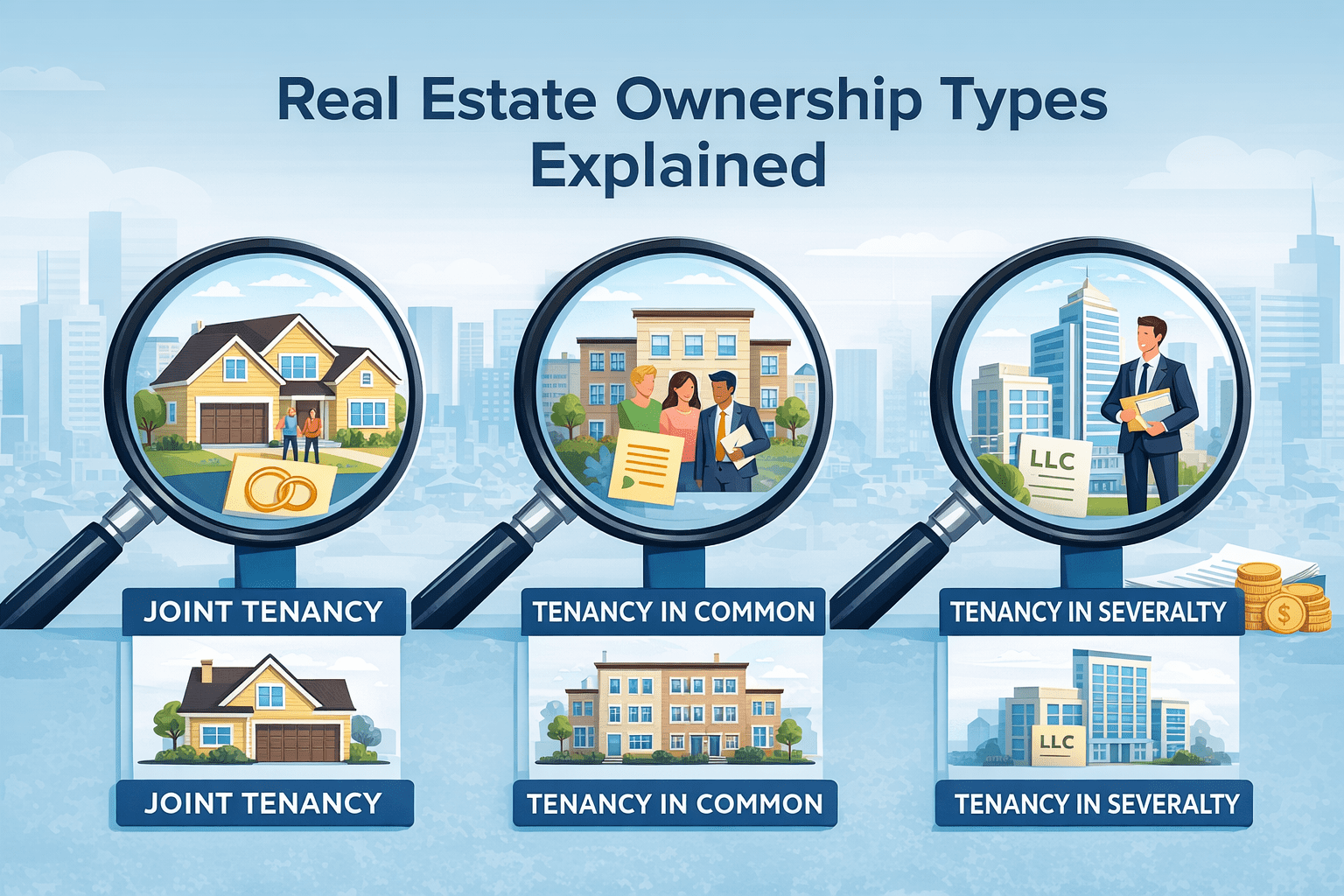
When people think about owning a home or investment property, they usually think in terms of location, price, and mortgage. But one of the most important pieces of real estate is often overlooked:
How the property is legally owned.
Ownership type determines what rights you have, who controls the property, what happens when someone dies, whether shares can be sold, and how risk is shared.
Whether you’re planning to buy your first home, invest with others, or structure property for the long term, understanding ownership is foundational.
If you’re early in the buying process, my Buyer Resource Hub is a great place to start building your full picture.
Tenancy in Severalty (Sole Ownership)
Tenancy in severalty simply means one person or one legal entity owns 100% of the property.
This could be:
- An individual buyer
- A married person owning alone
- A corporation or LLC
There are no co-owners. The single owner controls the property, receives all income, and carries all responsibility.
This is the most straightforward form of ownership and is common for:
- Individual homebuyers
- Rental property owners
- LLC-held investment properties
If you’re planning to use an entity for ownership, this pairs well with concepts covered in my Real Estate Investment Education section.
Tenancy in Common (TIC)
Tenancy in common is one of the most common ways multiple people own property together.
Key characteristics:
- Two or more owners
- Equal rights of possession
- Unequal ownership percentages allowed
- No right of survivorship
- Each owner may sell or transfer their share independently
Even if one owner holds 90% and another holds 10%, both have equal rights to use the entire property.
If a tenant in common dies, their interest passes to their heirs, not the other owners.
Tenancy in common is often used in:
- Investment properties
- Friends buying property together
- Family ownership arrangements
- Inherited real estate
It is a very flexible structure, which is why it appears so often in real estate investing scenarios.
Joint Tenancy
Joint tenancy is designed to treat multiple owners as one ownership unit under the law.
Its defining feature is the right of survivorship.
Key characteristics:
- Equal ownership interests
- Equal right of possession
- Interests acquired at the same time and by the same deed
- Right of survivorship
Right of survivorship means when one owner dies, their interest automatically passes to the surviving owners, not to heirs and not through probate.
A joint tenant may sell or transfer their interest, but once they do, their portion becomes tenancy in common, breaking the joint tenancy.
Joint tenancy is commonly used by:
- Married couples
- Family members
- Estate planning situations
This ownership form is very different from tenancy in common because it is designed around survivorship, not inheritance.
Community Property (Texas and Other Community Property States)
In community property states like Texas, property owned by married couples is divided into only two categories:
- Separate property
- Community property
Separate property includes:
- Property owned before marriage
- Property inherited by one spouse
- Property purchased using separate funds
Community property generally includes:
- Property acquired during marriage
- Income produced from community property
This distinction becomes extremely important in situations involving:
- Selling a home
- Divorce
- Estate planning
- Creditor claims
If selling is part of your future plan, these ownership rules directly affect how transactions unfold. My Seller Resources section explores that side of the process.
Why Ownership Type Matters More Than Most People Think
Ownership determines:
- Who can sell
- Who can inherit
- Who carries risk
- How creditors can pursue claims
- How property is divided
- How estate planning works
Two properties can look identical on paper but carry very different legal and financial consequences based solely on ownership structure.
Final Thoughts
Real estate ownership is not just a formality. It is the legal engine behind control, protection, inheritance, and financial outcome.
Understanding ownership before you buy, invest, or partner with others gives you leverage, clarity, and protection.
And in real estate, clarity always beats cleanup.